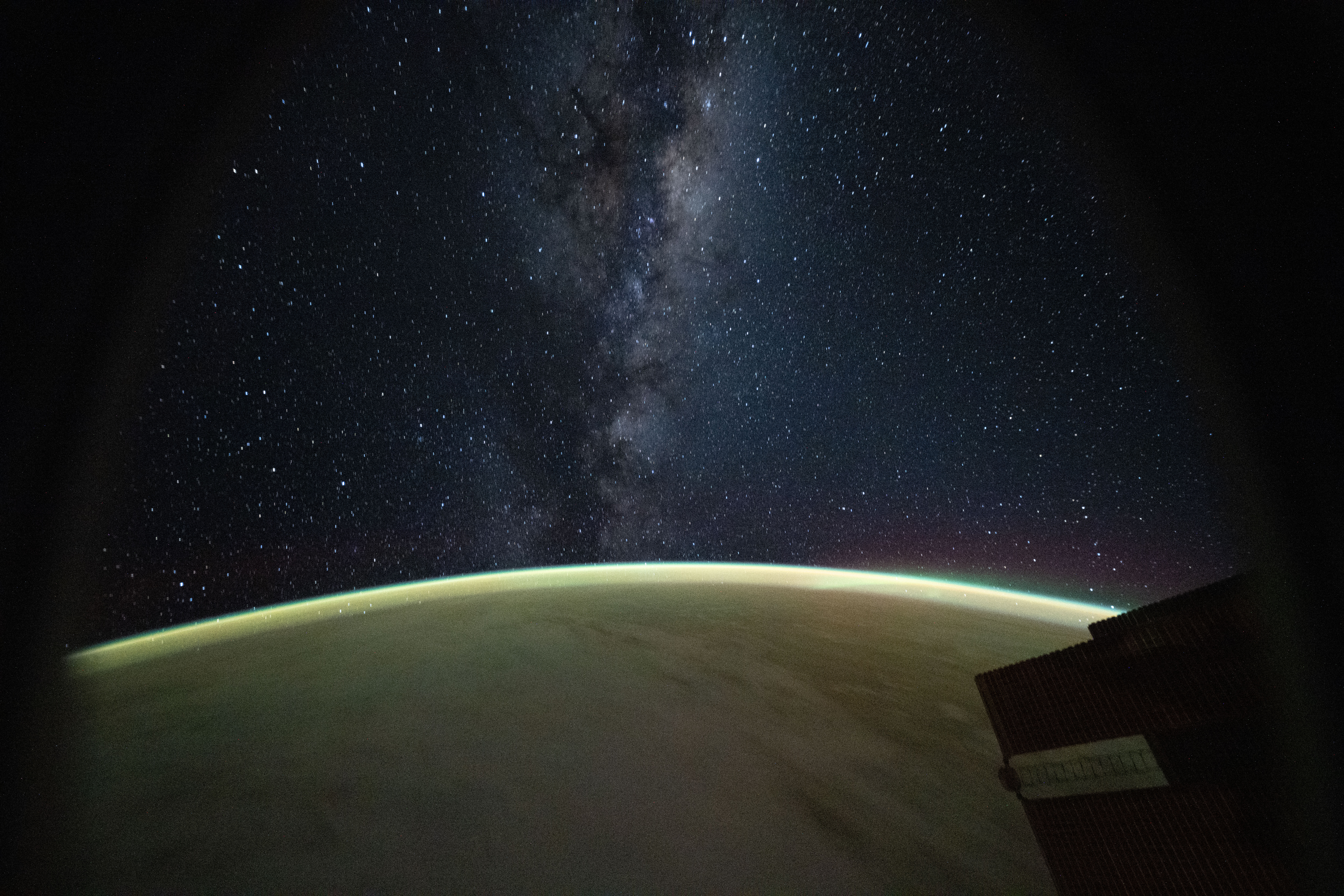
BREAKING — April 13, 2026 — NASA astronaut Chris Williams has captured an extraordinary image of the Milky Way rising above Earth’s luminous atmospheric glow while aboard a SpaceX Dragon spacecraft docked to the International Space Station (ISS).
The photograph, released by NASA today, shows a brilliant band of stars arcing over a shimmering, colorful halo of light surrounding our planet. This ethereal glow, known as airglow, is a natural phenomenon that occurs constantly in the upper atmosphere.
“Airglow is essentially the Earth’s own soft, steady light show,” said Dr. Sarah Jenkins, an atmospheric physicist at NASA’s Goddard Space Flight Center. “It’s caused by sunlight energizing atoms and molecules high above the surface, which then release that energy as faint light.”
What Is Airglow?
Airglow happens when atoms and molecules in the upper atmosphere — excited by sunlight during the day — emit light to shed their excess energy. Alternatively, ionized particles can capture free electrons, also releasing photons in the process.
“The mechanism is similar to how a neon sign glows,” Dr. Jenkins explained. “But instead of electricity, it’s solar radiation that kicks off the reaction.”
This phenomenon is distinct from auroras. Auroras are driven by high-energy particles from the solar wind colliding with Earth’s magnetic field. Airglow, by contrast, is powered by ordinary, everyday solar radiation.
Background
Astronauts aboard the ISS routinely observe and photograph airglow, but clear views of the Milky Way juxtaposed with the atmospheric glow are relatively rare. The image was taken from a SpaceX Dragon capsule, which provides unique viewing angles compared to the station’s main modules.
Chris Williams, a mission specialist on Expedition 73, used a high-sensitivity camera to capture the shot during a period of minimal glare from the station’s solar panels. The resulting photograph highlights the delicate interplay between our planet’s atmosphere and the universe beyond.
What This Means
Such images serve both scientific and inspirational purposes. Scientists can study airglow to learn about atmospheric composition, temperature, and dynamics. The data help refine models of Earth’s upper atmosphere and its response to solar activity.
“Each image of airglow gives us a snapshot of the chemical reactions happening hundreds of kilometers above our heads,” said Dr. Jenkins. “It’s a powerful reminder of how connected we are to the Sun’s energy, even when we can’t see it.”
For the public, the photograph offers a breathtaking perspective of Earth as a fragile oasis in the cosmos. NASA plans to feature the image in its upcoming “Earth from Space” exhibit.
Image credit: NASA/Chris Williams